
Clinical Technique
HA vs. Non-HA Dermal Fillers: How to Choose the Right Product for the Right Goal
A clinician's guide to choosing HA versus biostimulatory fillers like Radiesse, Sculptra, and Bellafill by goal, area, and reversibility.
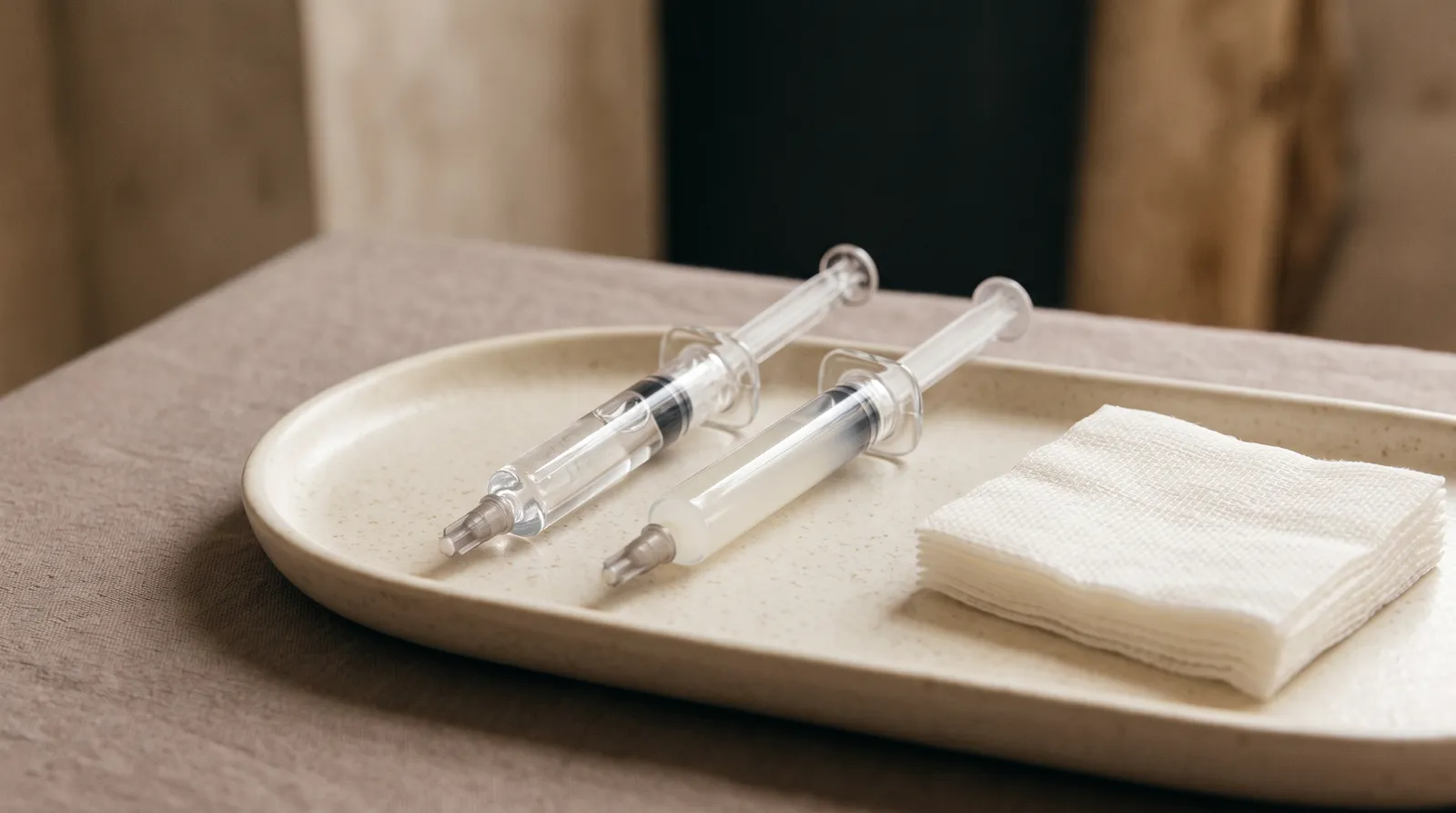
FAI Staff
FACE Aesthetic Institute
Dermal filler selection is no longer a one-product decision. Injectors now choose between hyaluronic acid (HA) gels and biostimulatory, non-HA options for nearly every consultation. Understanding how each category behaves mechanistically, and where each one fits clinically, is foundational to safe, predictable outcomes.
This article reviews the core science behind HA and non-HA fillers, walks through FDA-approved indications for major products, and outlines a practical framework for matching product category to patient goal, facial area, and risk tolerance.
Two Fundamentally Different Mechanisms
HA Fillers: Hydrophilic Volumizers
HA fillers are cross-linked gels of hyaluronic acid, a naturally occurring glycosaminoglycan already present in the dermis. Because HA is highly hydrophilic, these gels draw and bind water, producing immediate, visible volumization at the time of injection. The degree of cross-linking and manufacturing process (such as Allergan's Vycross or Galderma's Restylane NASHA and OBT technologies) determines how the gel behaves in tissue, including its firmness, longevity, and resistance to spreading.
Results are apparent immediately, which makes HA products predictable for volume correction and easy to titrate in real time. Over months, the gel is gradually broken down by natural hyaluronidase enzymes in the tissue, and the effect fades in a relatively linear, foreseeable way.
Non-HA Fillers: Biostimulatory Collagen Inducers
Calcium hydroxylapatite (CaHA, marketed as Radiesse) and poly-L-lactic acid (PLLA, marketed as Sculptra) work through a different mechanism entirely. Rather than relying primarily on the injected material to hold space, these products trigger the body's own wound-healing and foreign-body response to build new collagen over time.
Radiesse consists of CaHA microspheres (25 to 45 microns in diameter) suspended in a carboxymethylcellulose gel carrier, roughly 30 percent CaHA by volume. It provides immediate volumetric correction from the gel carrier itself, followed by a longer biostimulatory phase in which fibroblasts are activated and neocollagenesis proceeds around the microspheres as the carrier gel is resorbed.
Sculptra is a sterile, freeze-dried PLLA microparticle powder that is reconstituted with sterile water (typically 5 to 8 mL, hydrated for at least several hours to 24 hours, though immediate-use protocols have since been authorized) and often further diluted with lidocaine. PLLA has essentially no immediate volumizing effect. Instead, the microparticles incite a controlled foreign-body reaction, with macrophages and fibroblasts gradually depositing type I and III collagen around the particles over weeks to months. Clinical improvement is not visible for several weeks and builds progressively over multiple treatment sessions.
Bellafill (PMMA) is a hybrid: 20 percent polymethylmethacrylate microspheres suspended in 80 percent bovine collagen gel (requiring a skin test prior to treatment due to bovine collagen sensitivity). The collagen carrier provides immediate correction, while the non-resorbable PMMA microspheres form a permanent scaffold that the body continues to encapsulate with the patient's own collagen over three to six months, giving Bellafill its long-duration, semi-permanent profile.
FDA-Approved Indications: Know What You're Injecting For
Regulatory indications matter both clinically and medico-legally.
HA fillers carry a range of specific indications depending on formulation. Juvederm and Restylane product lines are FDA-approved for moderate-to-severe facial wrinkles and folds (including nasolabial folds), lip augmentation, cheek augmentation, and correction of infraorbital hollows. Indications have continued to expand. Juvederm Voluma XC received FDA approval for moderate to severe temple hollowing, and expanded indications have also reached chin and jawline augmentation for certain products. Injectors should always confirm the specific approved indication for the exact product and formulation being used, since indications differ meaningfully across the Juvederm and Restylane families.
Radiesse is FDA-approved for correction of moderate to severe facial wrinkles and folds, such as nasolabial folds, as well as for the correction of volume loss in the hands. It is also widely used off-label in diluted or hyperdiluted form for skin quality and neck/decollete indications, which providers should clearly disclose as off-label use.
Sculptra Aesthetic is FDA-approved for correction of shallow to deep nasolabial fold contour deficiencies and other facial wrinkles, and received expanded approval for cheek wrinkles. It also carries a distinct approval for restoration and correction of HIV-associated facial lipoatrophy, reflecting its origins in that population.
Bellafill is FDA-approved for correction of nasolabial folds and for moderate to severe, atrophic, distensible facial acne scars on the cheek in patients over age 21. It remains the only filler with a specific FDA indication for acne scarring, and prescribing information cites correction lasting up to five years for nasolabial folds based on pivotal trial data.
Rheology: Why G Prime and Cohesivity Drive Product Choice Within HA Fillers
Even within the HA category, product selection should be guided by rheological properties, not brand familiarity alone.
Elastic modulus (G prime) describes a gel's resistance to deformation under mechanical stress and its ability to return to its original shape. Higher G prime products (often in the range of roughly 200 to 300 Pa, depending on measurement method) hold their shape under the dynamic forces of muscle movement and gravity, making them suitable for structural support in areas like the jawline, chin, and cheek. Lower G prime products deform more easily and integrate more smoothly into soft, mobile tissue, making them preferable for the lips and tear troughs, where a stiffer gel risks a palpable or visible edge.
Cohesivity describes how well a gel holds together as a mass rather than spreading through surrounding tissue. Higher cohesivity limits migration and helps a product retain its intended shape and location, which is particularly relevant in areas prone to product spread, such as the tear trough and lips. Lower cohesivity products flow and integrate more diffusely, which can be advantageous for superficial fine lines where a discrete bolus would be visible.
In practice, injectors match G prime and cohesivity to the biomechanical demands of the treatment area: high G prime, high cohesivity products for deep structural support; softer, less cohesive products for superficial or highly mobile tissue.
Typical Longevity: Setting Accurate Patient Expectations
Longevity varies by product, technique, injection depth, and patient metabolism, but general literature and prescribing information ranges are useful for consultation planning.
HA fillers generally last 6 to 18 months depending on the specific product and treatment area, with denser, high-G-prime products in low-mobility areas (like the chin or cheek) tending toward the longer end of that range, and lip or perioral applications tending to metabolize faster due to high tissue mobility and vascularity.
Radiesse is generally cited as lasting approximately 12 to 15 months, with some patients experiencing benefit up to 18 months, particularly in lower-mobility areas.
Sculptra has the longest reported duration among these categories, with clinical study data showing collagen-stimulated results maintained up to 24 months or slightly beyond in some patients, though it requires a series of treatments spaced weeks apart to reach full effect, unlike the single-session correction typical of HA and CaHA.
Bellafill is the clear outlier, with FDA trial data supporting correction lasting up to five years, consistent with its non-resorbable PMMA scaffold.
Reversibility: The Defining Safety Differentiator
Perhaps the single most consequential clinical distinction between these categories is reversibility.
HA fillers can be dissolved with hyaluronidase (available as Hylenex or Vitrase), an enzyme that breaks down the hyaluronic acid polymer. This makes HA the only filler category with a rapid antidote for overcorrection, nodules, asymmetry, or the most serious complication in aesthetic injecting: vascular occlusion. When a vascular event is suspected, high-dose pulsed hyaluronidase is a cornerstone of emergency management, and its availability is a major reason many injectors default to HA products, especially in high-risk zones like the glabella, nasal region, and periorbital area.
Non-HA fillers have no equivalent reversal agent. Radiesse, Sculptra, and Bellafill cannot be enzymatically dissolved. If overcorrection, nodules, granulomas, or a vascular complication occur with these products, management options are far more limited and may involve intralesional steroids, 5-fluorouracil, saline dilution and massage, laser therapy, or in refractory cases, surgical excision, none of which offer the speed or reliability of hyaluronidase.
This does not mean non-HA fillers are unsafe when used appropriately by trained injectors. It does mean the margin for error is narrower, and injector experience, anatomical knowledge, and conservative technique carry even greater weight when using biostimulatory or permanent products.
A Practical Framework for Product Selection
When matching filler category to patient goal, several questions help guide the decision:
Is the goal immediate, visible volumization, or gradual, natural-looking rebuilding of the patient's own collagen? Patients wanting same-day results for an event favor HA. Patients seeking a "no filler" impression of gradual improvement, especially for global facial thinning or skin quality, are often better candidates for PLLA.
How high-risk is the injection zone? In vascular danger zones (glabella, nasal tip and dorsum, temporal region), the reversibility of HA is a significant safety advantage that should weigh heavily in product selection, particularly for less experienced injectors.
What is the treatment area's biomechanical demand? Structural, high-movement areas (jawline, chin) benefit from high-G-prime HA or CaHA. Broad areas of volume loss with thin overlying skin (temples, mid-face in an older or thinner patient) are strong candidates for PLLA's diffuse, gradual collagen stimulation.
Is there a specific FDA-labeled indication that matches the clinical problem? For atrophic acne scarring, Bellafill is the only product with a direct FDA indication. For HIV-associated lipoatrophy, Sculptra carries a distinct approved indication.
How does the patient feel about a treatment that cannot be reversed? Informed consent for non-HA fillers should explicitly address the absence of a rapid reversal option, longer time to final result (for PLLA), and, for Bellafill, its long-term to semi-permanent nature.
Conclusion
HA and non-HA fillers are not competing products so much as complementary tools addressing different biological problems: immediate, reversible volume replacement versus gradual, durable collagen biostimulation. A well-rounded injector should be comfortable assessing rheological properties within the HA category, understand the distinct FDA indications and safety profiles of CaHA, PLLA, and PMMA, and counsel patients honestly about the longevity and reversibility tradeoffs of each option. Product selection should always follow patient anatomy, goals, and risk profile, not injector habit or product familiarity alone.
Sources
- U.S. Food and Drug Administration. FDA Executive Summary, General Issues Panel Meeting on Dermal Fillers. fda.gov/media/146870/download
- U.S. Food and Drug Administration. Sculptra P030050/S039 Approval Summary. fda.gov/medical-devices/recently-approved-devices/sculptra-p030050s039
- Merz Aesthetics. RADIESSE Injectable Implant, Instructions for Use / Mechanism of Action. radiesse.com
- Galderma. SCULPTRA (injectable poly-L-lactic acid) Instructions for Use. galderma.com
- Bertossi D, et al. "The Rheology and Physicochemical Characteristics of Hyaluronic Acid Fillers: Their Clinical Implications." PMC (National Library of Medicine).
- Landau M, et al. "Hyaluronidase for Dermal Filler Complications: Review of Applications and Dosage Recommendations." JMIR Dermatology, 2024.
Educational Disclaimer
This article is intended for professional educational purposes only and is directed at licensed aesthetic providers and trainees. It does not constitute medical advice and is not a substitute for hands-on clinical training, hands-on device or product certification, or direct supervised practice under a qualified preceptor. Always consult current FDA labeling, manufacturer prescribing information, and institutional protocols before performing any injectable procedure.
Continue reading
More articles.
Clinical Technique
Recognizing and Managing Vascular Occlusion in Dermal Filler Injection
A clinical guide for injectors on recognizing filler-induced vascular occlusion, danger zones, warning signs, and emergency hyaluronidase protocols.
FAI Staff9 min
Clinical Technique
Why Skin Quality Belongs in Every Injectable Consultation
Why skin quality assessment belongs in every injectable consult, and how to sequence skincare, biostimulators, and devices with toxin and filler.
FAI Staff8 min
Clinical Technique
Laser Physics Fundamentals and Chromophore Targeting: A Clinical Primer
Learn selective photothermolysis and chromophore targeting (melanin, hemoglobin, water) to guide laser device selection for aesthetic providers.
FAI Staff9 min
Clinical Technique
Lip Anatomy, Aging, and a Practical Typology Framework for Filler Treatment Planning
A clinical guide to lip anatomy, aging changes, and a practical typology framework for aesthetic injectors planning filler treatments.
FAI Staff8 min